 By Ritvars Mētra, Founder of ReadinessCompass
Organizations keep changing because the world keeps moving. That part is almost too obvious to write down. Markets shift, technologies mutate, customers become less patient, regulators intervene, competitors copy, employees burn out or leave, and suddenly yesterday’s operating model starts to look like a museum exhibit.
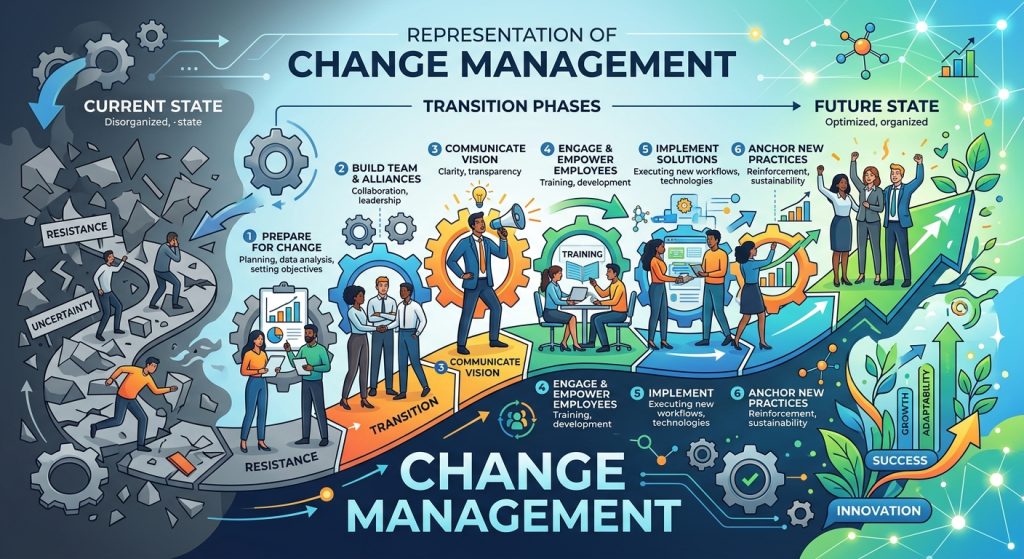
So we reach for change management.
At its most basic, change management means making changes in a planned and systematic way. That definition is useful, but slightly misleading. It gives the impression that organizational change is mainly a matter of sequencing activities: diagnose, plan, communicate, train, implement, stabilize. And yes, those steps matter. But the research tells a more stubborn story. Change management is not only the ordering of tasks. It is the ordering of human attention, belief, anxiety, politics, skill, and commitment — all while the organization is still trying to do its normal work.
A major review by Errida and Lotfi examined 37 organizational change management models and found that no single model covers the whole field. The same paper notes the familiar, somewhat depressing estimate that 60–70% of organizational change initiatives fail, which is perhaps overquoted, but still useful as a warning sign: the existence of many models has not made change easy.
- Change management models are helpful, but they are incomplete maps, not magic recipes.
- Most models fall into two broad families: processual models that describe steps, and descriptive models that diagnose forces, systems, and conditions.
- People readiness is not “positive attitude”; it is a specific set of beliefs about need, fit, capability, leadership support, and personal consequences.
- Communication, participation, leadership, training, sponsorship, and reinforcement keep appearing across the literature — which tells us something.
- Politics is not an unfortunate side issue. It is part of the terrain.
The model zoo: useful, crowded, and slightly confusing
The change management literature has become crowded with frameworks: Lewin, Kotter, Lippitt, Bullock and Batten, Bridges, ADKAR, AIM, ACMP, McKinsey 7-S, Burke-Litwin, Nadler-Tushman, Knoster, Prosci, and many more. Errida and Lotfi classify these models into two broad groups: processual models, which describe the steps or phases of change, and descriptive models, which explain the variables that influence change outcomes.
That distinction matters more than it first appears. Processual models tell you what to do next. Descriptive models help you understand why things are not working.
Processual models: the comfort of steps
Lewin’s three-stage model — unfreezing, moving, refreezing — remains the old skeleton underneath much of modern change management. Kotter’s 8-step model expands the logic: create urgency, build a coalition, form a vision, enlist volunteers, remove barriers, generate short-term wins, sustain acceleration, and embed the change. Kotter’s own current description still emphasizes urgency, coalition-building, removing barriers, and short-term wins.
Lippitt et al.’s change theory follows a similar planned-change tradition: diagnose the problem, assess motivation and capacity, create a plan, develop commitment, implement, evaluate, and stabilize. Bullock and Batten simplify planned change into four phases: exploration, planning, action, and integration. Bridges’ transition model shifts the lens. It says the visible change is not the same thing as the human transition. People must go through endings, the neutral zone, and new beginnings — and the neutral zone is often where the emotional mess lives.
ADKAR is more explicitly individual: Awareness, Desire, Knowledge, Ability, Reinforcement. Prosci describes these as the five outcomes an individual needs to achieve for a change to succeed. There is nothing wrong with any of this. The danger is when leaders treat steps as proof of progress. A town hall happened, therefore awareness exists. Training was delivered, therefore ability exists. Sponsors attended a steering committee, therefore leadership support exists. Not quite.
Descriptive models: the less tidy question of fit
Descriptive models are less linear. McKinsey’s 7-S asks whether strategy, structure, systems, staff, style, skills, and shared values fit together. The Burke-Litwin model looks at deeper drivers such as external environment, leadership, culture, management practices, systems, motivation, and performance. Nadler and Tushman’s congruence model asks whether work, people, formal arrangements, and informal organization align.
These models are not as easy to turn into a project checklist, but they often explain why the checklist fails. A system change may be technically live, but the performance metrics still reward old behaviour. A new operating model may be announced, but decision rights remain politically ambiguous. A new process may be documented, but the informal organization — the real network of influence — quietly ignores it. That’s not resistance in the childish sense. It’s misfit.
What the research keeps finding, again and again
Errida and Lotfi’s review identified more than 70 change success sub-factors across the models they studied, later grouped into 12 broader categories. The recurring factors are not especially surprising: clear vision, readiness, communication, stakeholder engagement, leadership and sponsorship, resistance management, training, motivation, structured planning, monitoring, and sustainment. The surprise is not what appears. The surprise is how often organizations still underinvest in precisely these basics.
Their case study is useful because it gives hard numbers. In a Moroccan construction company, a successful project management methodology implementation was compared with a less successful lean construction initiative. On a five-point scale, respondents rated leadership and sponsorship at 4.53 in the successful case versus 1.3 in the unsuccessful one. Effective communication scored 4.3 versus 1.2. Stakeholder engagement scored 4.25 versus 1.25. Change readiness and capacity scored 3.3 versus 1.6.
Those numbers are blunt. They don’t prove universal law, of course. One case study is one case study. But they do show something practitioners recognize: change rarely fails because one PowerPoint slide was missing. It fails because leadership, communication, readiness, engagement, and practical support are weak at the same time.
People readiness: the part many models mention, but few leaders measure well
The science on readiness is clearer than many business conversations suggest. Holt, Armenakis, Feild, and Harris developed a readiness scale using more than 900 organizational members across public and private-sector settings. They found readiness is multidimensional, shaped by whether employees believe: they can implement the change, the change is appropriate, leaders support it, and the change is personally beneficial.
Armenakis and colleagues later refined this into five change-recipient beliefs:
- Discrepancy: Do people believe change is needed?
- Appropriateness: Do they believe this change is the right response?
- Efficacy: Do they believe they can succeed?
- Principal support: Do they believe credible leaders and influencers support it?
- Valence: Do they believe the change has benefit or meaning for them?
The authors describe these beliefs as precursors to resistance or supportive behaviour — which is a subtle but important shift. Resistance is not treated as a mysterious personality defect. It is often a predictable response to weak beliefs.
Weiner’s theory adds a collective layer. Organizational readiness, he argues, is a shared psychological state built from change commitment and change efficacy. People must value the change, and they must believe the organization has the capability to implement it. That capability judgment depends on task demands, resources, and situational factors. This is where many change programmes get exposed. They ask employees to be ready, but don’t reduce workload. They ask managers to sponsor, but don’t clarify decision rights. They ask users to adopt, but leave process conflicts unresolved.
Politicking: the shadow process inside change
Every large change has an official process and a shadow process. The official process has governance decks, milestones, decision logs, design principles, change impact assessments, training plans. The shadow process has coalitions, trade-offs, quiet resistance, career calculations, local loyalties, budget protection, status anxiety, and the small art of waiting until a sponsor loses interest.
It would be comforting to call this dysfunction. Sometimes it is. But it is also normal organizational life. Several established models explicitly recognize political support. In Errida and Lotfi’s mapping, Cummings and Worley include “developing political support,” while Jick’s model includes lining up political sponsorship. Carnall’s model also highlights the managerial skill of establishing the politics of organizational change.
This is important because naïve change management assumes that people resist because they don’t understand. More often, they understand quite well. They understand who wins, who loses, who gets blamed, whose work becomes visible, whose expertise becomes obsolete, and which leader is probably moving to another role before the consequences arrive. So yes, communication matters. But communication without power analysis is a bit innocent.
The change agent is not a cheerleader
The phrase “change agent” can sound fluffy, almost theatrical. In practice, the change agent is often the hinge between strategy and lived reality.
The research points to a demanding role. Change agents must help employees develop the right knowledge, skills, and abilities, but they must also assess whether the organization has the right structures, policies, procedures, technologies, management support, and resources. Weiner’s theory makes this distinction neatly: readiness is not only motivation; it is also an appraisal of task demands, available resources, and situational constraints.
Errida and Lotfi’s case study says something similar in less theoretical language. In the successful implementation, the change manager combined project management and change management knowledge, used planning and stakeholder management, and worked through communication, resistance management, and empowerment. In the failed lean case, the designated change manager lacked the leadership traits needed to mobilize stakeholders, communicate, motivate, empower, and develop change plans.
That feels uncomfortably practical. A change agent has to do at least four things at once:
- make sense of the change for different groups;
- surface resistance before it hardens into sabotage or withdrawal;
- translate strategy into changed routines;
- protect the psychological credibility of the programme when reality becomes messy.
And reality always becomes messy.
What a science-informed change approach should actually do
A more mature approach to change management would stop worshipping models and start using them as diagnostic lenses. Kotter can help with movement and coalition. Bridges can help with emotional transition. ADKAR can help with individual adoption barriers. McKinsey 7-S can expose organizational misalignment. Weiner and Armenakis can help measure readiness beliefs. ACMP’s standard is useful because it formalizes change impact and organizational readiness as part of professional practice.
The practical rhythm might look like this:
1. Define the change without pretending it is smaller than it is
What exactly is changing — process, system, structure, roles, decision rights, behaviours, metrics, identity? Many organizations define the technical change and hide the social one.
2. Diagnose readiness by belief, not by mood
Don’t ask only whether people feel positive. Ask:
- Do they see the need?
- Do they believe the solution fits?
- Do they trust the sponsors?
- Do they believe they can perform in the new model?
- Do they see credible benefits?
3. Treat communication as sense-making
Communication is not a broadcast function. It should help people interpret what the change means for their work, their status, their risks, and their competence. If the message avoids the real pain points, employees will fill the silence themselves — usually with better information than leaders expect, and worse conclusions than leaders want.
4. Manage politics openly enough to be useful
Who must support the change? Who can block it? Who loses informal power? Who needs to be brought into the coalition early? Which middle managers are quietly decisive? The political map is not dirty. It is data.
5. Build capability and adjust the system around the person
Training alone is thin. People need practice, coaching, time, feedback, aligned KPIs, process clarity, and a manager who does not punish the learning curve.
6. Reinforce before the old way returns
The most dangerous moment is often after go-live or launch, when the project declares victory and the organization quietly reverts. Sustainment is not a celebration email. It is the redesign of routines, measures, support structures, and consequences.
The paradox: planned change is necessary, but never enough
The old definition still works: change management is the planned and systematic making of change. But the better definition is less neat. Change management is the disciplined attempt to help an organization move from one way of working to another while dealing honestly with belief, capability, politics, emotion, and habit.
That is why the models matter. And also why the models are not enough. A process can tell us when to communicate. Science tells us what people must come to believe. A roadmap can identify milestones. Politics tells us who can quietly derail them. Training can teach the new method. Readiness tells us whether people think the new method is worth using.
Maybe that is the most useful way to see it: change management is not the removal of chaos. It is the creation of enough shared meaning, structure, and confidence that people can act despite the chaos.
Not elegant. But much closer to the work.
If you want the individual frameworks examined rather than dismissed, each is worth taking on its own terms: what ADKAR sees and where it runs out, which of Kotter’s eight steps survive a fixed-date programme, what actually holds up in Lewin, how to choose between them, and why maturity models rarely change anything.
Related reading on sponsorship, decision-making and executive communication is collected in the transformation leadership archive.