ReadinessCompass Score
Change readiness is not a snapshot. It is a KPI.
The ReadinessCompass Score is a structured people readiness assessment for complex business transformations. Unlike a one-time change readiness assessment, it measures how organisational readiness develops from strategic mobilisation through functional preparation to operational go-live. It turns employee and manager evidence into a longitudinal readiness KPI that leaders can track, compare and act on.
Why RCS
Key questions the RCS Assessment answers
- Is readiness improving or deteriorating?
- Which functions are falling behind?
- Can people perform the new work on Day 1?
- Where should leaders intervene first?
Interactive demonstration using synthetic transformation data.
Beyond the snapshot
A single survey provides a snapshot. The ReadinessCompass Score Assessment creates a management KPI.
Staged measurement
A staged measurement system for the people side of transformation
The ReadinessCompass Score Assessment is a staged organisational measurement system designed for ERP, CRM, AI, digital and operating-model transformations. It combines a stable set of core readiness indicators with stage-specific dimensions that reflect what matters at each point in the programme.
Strategic Readiness
6–18 months before go-live
Measures whether employees understand the transformation, see value in it, trust its direction and are psychologically prepared to engage.
Functional Readiness
3–6 months before go-live
Measures whether functions, managers and impacted groups understand what will change and whether roles, processes, capabilities, communication and local support are developing.
Operational Readiness
2–6 weeks before go-live
Measures whether people believe they can perform the new work, use the new processes and systems, access support and operate successfully from Day 1.
Connected measures
One comparable KPI across the readiness journey
The ReadinessCompass Score Assessment does not produce a single undifferentiated number. It generates several connected measures that together give leaders a complete view of organisational readiness.
Core RCS
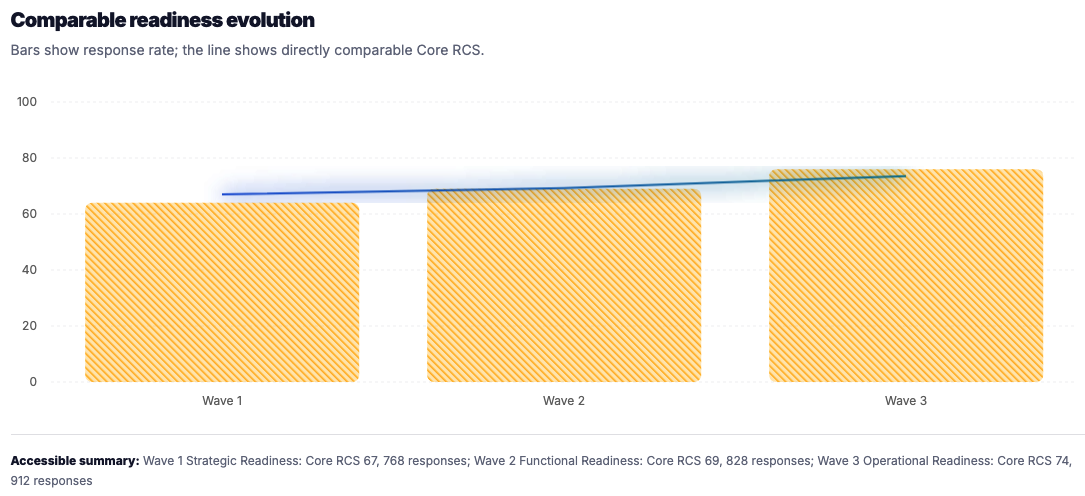
A stable, comparable longitudinal KPI measured across assessment waves. It enables leaders to see whether the organisation’s underlying readiness is improving, stagnating or deteriorating.
Factor scores
Several factor-level scores explain what is driving the headline result. They help leaders distinguish between issues such as confidence, leadership trust, manager support, communication, functional preparedness and adoption conditions.
Stage-specific readiness
Each assessment wave includes measures that reflect what matters at that point in the transformation lifecycle. This provides context that a generic one-time score cannot provide.
Day-1 Preparedness
The final operational wave includes a separate Day-1 Preparedness KPI. This gives leaders a focused indication of whether employees believe they can perform the new work when the transformation goes live.
Leaders can use the RCS Assessment to review organisation-level movement, function and business-unit differences, strong and weak readiness factors, current-stage gaps, Day-1 Preparedness, and areas requiring management action.
Explore the RCS Demo Dashboard
Explore a fictional ERP transformation using synthetic data.
Leadership value
What the RCS Assessment gives transformation leaders
Earlier risk visibility
Detect people-readiness gaps before they become cutover, stabilisation, adoption or value-realisation problems.
Longitudinal evidence
Track whether readiness is improving across the programme rather than relying on a one-time survey.
A comparable management KPI
Give steering committees a consistent people-readiness indicator alongside technical, operational and delivery measures.
Targeted intervention
Identify which functions, organisational groups and readiness factors require focused action.
Better leadership conversations
Replace broad statements such as ‘people are resistant’ with structured evidence, clearer priorities and more specific ownership.
Connection to adoption
Create continuity between pre-go-live readiness measurement, Day-1 Preparedness and post-go-live adoption governance.
A readiness assessment tool for transformation leaders
Transformation leaders, programme managers, change managers and functional leaders use the RCS Assessment to compare readiness across functions, identify teams that need support and prioritise interventions before go-live. Factor scores and assessment-wave trends turn employee and manager evidence into a management view designed for steering committee review, clear ownership and targeted action.
As a business transformation readiness assessment, it supports ERP, CRM, AI, digital and operating-model programmes without reducing readiness to a single point-in-time result.
Process
How people readiness assessment works
The RCS Assessment is more than issuing a survey. It is a structured process that connects evidence to leadership action.
Define the assessment scope
Confirm the transformation stage, participating organisational groups, functions and reporting requirements.
Launch the appropriate assessment wave
Use the stable core indicators together with the stage-specific readiness dimensions relevant to the current programme phase.
Calculate and segment the results
Produce aggregated views for the organisation, functions, business units and other relevant groups.
Interpret strengths, gaps and movement
Assess the current readiness position, compare relevant waves and identify material readiness risks.
Translate evidence into action
Connect the results to interventions, owners, leadership decisions and the next measurement cycle.
Next step
Apply the RCS Assessment to your transformation
Explore the demonstration
See how longitudinal readiness evidence can be presented across strategic, functional and operational assessment waves.
The demo uses synthetic transformation data and contains no client or respondent information.
Run a focused assessment
Use the Readiness Diagnostic Sprint to examine your transformation context, readiness risks, management priorities and practical next actions.
Looking for broader context before you run an assessment? Explore change readiness resources and guidance for curated articles, assessments and tools covering readiness foundations, adoption evidence and turning survey findings into leadership action.
Questions
Frequently asked questions
What is a change readiness assessment?
A change readiness assessment is a structured evaluation of whether an organisation is prepared to adopt a planned transformation. It goes beyond technical delivery status to examine whether people understand the change, have the capability to operate in the new environment, and are supported by managers and systems needed for successful adoption.
How is the ReadinessCompass Score Assessment different from a standard employee survey?
A standard employee survey typically captures sentiment at a single point in time. The RCS Assessment is a staged measurement system that repeats across the transformation lifecycle, combines stable core indicators with stage-specific dimensions, and produces factor-level scores that leaders can compare across functions, organisational groups and programme phases.
What is the ReadinessCompass Score?
The ReadinessCompass Score (RCS) is a longitudinal people readiness KPI. It is calculated from multiple factor scores and enables leaders to track how organisational readiness develops from strategic mobilisation through functional preparation to operational go-live.
When should readiness be measured?
Readiness should be measured at multiple points across the transformation lifecycle: during strategic mobilisation (typically 6–18 months before go-live), during functional preparation (3–6 months before go-live), and during the final operational readiness phase (2–6 weeks before go-live). Each wave captures what matters at that stage.
Can RCS results be compared across functions or business units?
Yes. The RCS Assessment is designed to support function-level and organisational-group comparisons. This makes it possible to identify which areas of the organisation are ready, which are lagging, and where management attention should focus.
What is Day-1 Preparedness?
Day-1 Preparedness is the final operational readiness indicator produced by the RCS Assessment. It gives leaders a focused measure of whether employees believe they can perform the new work, use the new processes and systems, and access the support they need when the transformation goes live.
Is the demo based on real company data?
No. The interactive demo uses entirely synthetic transformation data created for demonstration purposes. It contains no real company, client or respondent information.
Does the RCS produce a simple Ready/Not Ready decision?
No. The RCS produces a nuanced set of connected measures including a core longitudinal KPI, factor-level scores, stage-specific indicators and Day-1 Preparedness. This gives leaders a detailed view of readiness rather than a binary classification.
Is the RCS Assessment only for ERP transformations?
No. While the RCS Assessment was developed with deep ERP transformation experience, it is designed for any large-scale organisational change including CRM implementations, AI adoption programmes, digital transformations and operating-model changes.
How does readiness measurement relate to adoption?
Readiness measurement creates a direct connection between pre-go-live preparation and post-go-live adoption. By tracking readiness across transformation stages, leaders can identify and address adoption risks before go-live, set a baseline for Day-1 Preparedness, and maintain evidence-based adoption governance after the system is live.
How do managers use readiness assessment results?
Managers use RCS results to compare functions and organisational groups, identify the readiness factors requiring attention, assign intervention owners and track whether subsequent actions improve readiness in the next assessment wave. The results support management decisions; they do not replace local judgement or direct engagement with affected employees.
What is the difference between change readiness and go-live readiness?
Change readiness describes whether people are prepared to understand, support and adopt a transformation across its lifecycle. Go-live readiness focuses more narrowly on whether employees can perform the new work when new systems, processes or responsibilities become operational. The RCS Assessment tracks the wider readiness journey and reports Day-1 Preparedness separately in the final operational wave.